Showing posts with label Chinatown. Show all posts

Thursday, February 19, 2009

Thesis Statement v.2 from Chinatown

“Migrancy means not only changing places, it also means the changing nature of places.”

“Life is not made up of landmarks and destinations, but a series of passageways.”

The idea of entering a new surrounding and leaving ones home brings about physical displacement and a series of mental unknowns. This unfamiliarity challenges one’s sense of belonging. Individuals are limited from bringing their home in transition to a new permanence. Therefore if home represents a place of belonging, then it is also the boundaries of comfort.

Taking on the idea of a traveling soul where he or she is constantly adapting to a new culture and pace and style of life. How does such an individual find ease and comfort in this transition?

Comfort is found sometimes amongst those of the same kind, resulting individuals from similar origins often tend to bond faster and easier hence the beginnings of various ethnopolis.

It is not just about the movement made by individuals or groups from one locality to another. It is also associated with the transformations acted upon the landscape of the new territory. The adaptation of the (pre)existing local vernacular represents the occurrence of homeland nostalgia.

-- -- --

Using Chinatown (a parasite) as a primary example of the transformation of any city, where alterations have been made indifferent to the urban vernacular at large. The constant (over)flow of immigrants caused an increase in racial discrimination, leading to the creation of ghettos.

Chinatown’s layers of history makes it hard to be defined; however it has acted constantly though out history as a trading post and a centre of refuge. Perhaps it is because of its dense layer of history that has extended its life expectancy, preserving the ‘minor’ alterations to be imprinted on the landscape in which it sits in – making it a landmark. (So where or what are the passageways?)

Sunday, February 15, 2009

Chinatown Map

Below is the map which i've created to locate most of the Chinatowns in the World.


Monday, February 9, 2009

Extra! Extra! Read all about It!


The Falcon's Return by Gill Stoner raised an interesting topic. The Falcons that were endangered due to the poisoning of wildlife by our civilization-ing have been brought over to be raised in the urban jungle. Since the tall skyscrapers are just as tall (if not taller) than those of the forest (due to deforestation), the urban conditions have proved to be better and safer for these birds. (...which explains the increasing numbers of birds (hawks and eagles) that i see out of my window in Hong Kong, amongst the skyscrapers!)

The 'nature' in the city is often related to the green parks and the trees located on the side walk. However, " the urban landscaping is no more natural than urban pets, which are conditioned to sleep on couches, eat supermarket food and wear coats when it rains...the contemporary city, born of the forces of corporate capitalism, is now our own second nature." Strategies for survival has resulted in the growth of animals we consider as pests to live in the city. Rats, Pigeons, Seagulls, Cockroaches, raccoons and many more are no longer surviving in their natural habitat, but rather ours. If we disregard what we used to consider rural and urban, (wildlife versus city), the old urban has become the new 'rural', so what is the new 'urban' going to be?

If the existing conditions/ context has come into terms for a new landscape/ ground, then is the re-appropriation done Chinatown considered okay - acceptable? a decorated shed fit for advertising? would it be comparable to the 'big chicken' or 'duck house' ?

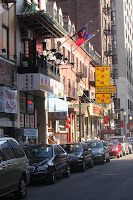
As I walk through (the new/surviving) Chinatown in Boston (this time carefully noticing the architecture), in many sense the streets are full of advertisements! Part of a business tactic... using signs instead of the shouting ‘one dollar, one dollar.’, or having news boys shouting ‘Extra! Extra! Read all about it...’ . Signs located everywhere, added on to the facade above entrances or even protruding out perpendicular to the building. The pre-existing brick commercial buildings and low-rise row houses, has been re-imaged due to homeland nostalgia. As a method of claiming the entry to the community, archways were built despite their awkward setting/ relationships to the surrounding buildings. Despite the changing architecture, the street view of these Chinatowns are outrage and re-appropriated to distinguish familiarize themselves with the sense of home.


Today, Chinatown is a part of the varied heterogeneous American fabric in which Chinese ethnic expression is woven into the American urban scene. The building of archways no longer stand for its old meanings; rather, a commercialization tactic by the city council. This development of the Chinatowns across the world has been quite similar politically, economically and historically.

It seems that Chinatown has become a form of parasite, that is globalized everywhere. As these Paifangs become the symbol, do they become the Starbucks sign for Chinatown? The intention of recreating the existing context to a preferred landscape that is like that of home is lost. Chinatown has now become a commodity, and a place for finding Chinese-ness, not Chinese.

What is the future of Chinatown?

Thursday, February 5, 2009

Networking


Chinatowns are located due to migration. They have always acted as trading posts, apparently due to their capability in business. With the enactment of the Treaty of Peking in 1860, which opened the border for free movement, the numbers of emigration to other parts of the world from China accelerated. Coincidentally, the increasing European colonization in Asia during the mid 1800s resulted in the mass Chinese migration overseas on western ships (steamers). It has been said that from 1868 to 1939 about 6.3 million Chinese left Hong Kong as slaves for the coolie trade. What started out mostly as slavery for the gold rush, located in Australia, North America, Africa ad New Zealand, slowly turned into slavery for the railway industry.

Although the Chinese migrants all came from the coastal area of Guangzhou China, those of different dialects/ linguistic lines traveled to different parts of the world. The Taishanese and Cantonese settled in North America, Australia, Europe and Latin America; whereas the Hokkien and Teochew, moved down to Southeast Asia, Africa, Europe and later, Latin America.
Using these old maps that traced the paths of the Steam-liners taken by Chinese Immigrants, the path taken and stops made concludes the location of various 'major' / 'old' Chinatown.

By studying these routes taken by the steam ships, we can begin to define the origin of each Chinatowns. The pattern of movement across the world map refers to the patterns of migration. Furthermore, understanding that with the spread of word by mouth or letters, more men were bound to travel to locations where they heard of success.

Because of these occurrence, we are able to identify through the style of paifang/ archways the origins of the immigrants. (in this case it would be the regions/ villages in China.)


The paifang dates back to the Zhou Dynasty 11th Century, represented as a marker for entrances, building complexes, mausoleums, temples, bridges, parks or towns. They served as directions, decorating the neighboring community, and used to honor and commemorate deserving people or historic events.

By the Song dynasty, it became more of a decorative movement - losing its true meaning.
Surprisingly, it is arguable that the original intent for the construction of the paifang/ archway in Chinatown is to reroot oneself in the new surrounding. But over the course of history, as Chinatown grows and become globalized, the archway now serves as a means of branding for tourism and commercialization of the area (as promoted by the city-council to reduce the vice of the city due to prostitution and drug use).

The disregard of the existing context/ ground (local vernacular) shows the re-appropriation to be used to feed the need of the people to re-root or familiarize themselves on foreign soil. As ignorance is placed upon the historical (pre)existing industrial architecture the street view is made to remind of home. Resulting with a additive architecture that become inconsiderate to the existing structures or surroundings.

Saturday, January 31, 2009

is Chinatown a ghetto?

Migrancy means not only changing places, it also means the changing nature of places.” The idea of architecture by migrancy which is based upon the coming and going of people is unavoidable in this day and age. As our footprint is traceable and imprinted upon the landscape travelled. Wherever we go, part of us gets left behind. Whether it is the rubbish that we have left in the area, or the scars we have left in the landscape. (Monuments, landmarks and buildings we have built).


“Life is not made up of landmarks and destinations, but a series of passageways.”

If landmarks and destinations are viewed as solids or positive spaces, then the moment of transient/ transition which occurs are what that defines the solids. Therefore leaving passageways as the void that we live through unnoticeable, seeing, hearing and learning. These “meaningless” or insignificant spaces are what that provides definitions to the solid that is around it. Their ‘emptiness/ voidness’ services the harmonization of the two distinct opposites (ying and yang). These spaces – passageways if viewed in terms of Lao Tsu’s argument, would be the greyness that provides clarity to the contrasts of the black and white (which in this case would be the Landmarks and destinations).


The transformation/ evolution of the city is altered by its people – migrants. This can be applied to any area, at any point of history and time. The occurrence of these small dislocations may signify the homeland nostalgia, which explains the generation of the beginnings of ethnopolis (Little Italy, Chinatown, etc.). ‘The plain “vernacular” is appropriated by capital and transformed into desirable “landscape”.’ However commercialism has been the key that drives the transformation of the city, therefore ultimately indifferent to the urban vernacular at large.

Take any Chinatown per se, the aspiration of the space provides a false sense of belonging – as though you were in China but on foreign soil. It can be perceived as a place whose self definition is actually portrayed in the symbolic landscapes and the re-appropriation of the vernacular spaces. (Although this might be a false image and wrongly perpetrating the true identity of the place.)


Looking at the history of Chinatown, despite their dispersed locations, they are mostly close to the sea. This pertains to their historical relevance of seamen traveling around the world to look for jobs and earn money to send home. The money they send home helps to raise their family, their success is spread by word of mouth to others in the homeland and thus provoking others to do the same.


As more people arrive, discrimination towards the Chinese increases: mostly due to the cheap Chinese laborers that become competitors to the local laborers. By isolating themselves from the rest of the society, and congregating to live together protects them from the others – creating a comparable center of refuge.


The following experiences would be a brief historical recount on what I think can be applied to mostly all Chinatowns - a stage of male dominant cheap laborers, drug and prostitution center (red light district or association with oriental exoticness), discrimination (exclusion), (finally) arrival of families, women and children, establishment of institutions and self-governing associations, commercialization and finally tourism.


The purpose of any refugee center is to facilitate or assist the resettlement of immigrants and multi-ethnic communities. Does the early stages of Chinatown fit into this description? Or perhaps this is where Chinatown is comparable to a ghetto. Despite the progression it has made though history, it start off as a poor section of the city with a high populated slum inhabitant of people of the same race and social background; resulting from social and economic restrains and pressure and hardships due to the occurring stereotypes.


With these layers of meaning that goes into the concept of Chinatown makes it wonderfully elusive – hard to define. Its layers are incorporated with the landscapes which it sits in. Wherever these Chinatowns are located, they have transformed the local architecture and urban design of that certain region of the country. The effects of migrancy have left behind landmarks, engraving their homeland nostalgias in the landscapes.


As we transit into this ethnopolis (Chinatown) most of us are unaware of the minor adjustments made by the migrants. The alterations are so minute that the awkward fitting-in goes unnoticed unless there is a arch that signifies the entry. We walk through the passageways, only experiencing the transition into a new environment through our senses.

Sunday, January 25, 2009

Chinatown (S)

chinaSo as I begin researching about different methods of alternations/ adaptations of local vernaculars, I thought what a good way it would be by looking for something consistent around the world - to my realization it was Chinatown(s). It is apparent to me that there is always a Chinatown somehwere you go, or located closeby. Whether it be a giant community or a small couple of shops.

Here we go.....


Apparently there is only one Chinatown in India. Located in Calcutta. Here is a clip of the place. Although it is in Hindu, I suppose you can get the gist of the place with the few lines of spoken English and of course if you can recognize the Chinese characters.


As a method of tracking these discoveries, I made a google map of these Chinatowns.