Showing posts with label Migratrion. Show all posts

Friday, February 20, 2009

Chungking Express

While researching about Chungking Mansion, I remembered that this movie directed by Wong Kar Wai - "Chungking Express", was actually based there. It is an anthology about Indian drug smugglers, Chines cops and short-order cooks.  Wong Kar Wai grew up in Tsim Sha Tsui, Kowloon, in the shadow of the Mansion, he quotes about his memories : 'The place was always a mystery to me. The people living in and living on it seemed very different from those I encountered. You can't help but have fantasies about what was actually happening inside. Of course, as a child, I was prohibited by my parents from visiting the place."  

- quoted from Hope and Squalor at Chungking Mansion by K.T. Greenfeld

On many levels I can relate to the curiosity generated by the presence of this building. I walked by this building every Saturday evening, after visiting my father at his office. As years go by, the crowd in front of the building changes. Sometimes, there were a crowd of Indian Women surrounding the area. (which I'd presumed to be prostitutes). next came the various individual Chinese woman standing on the street corners, alone in skimpy little clothing, covering barely any skin. I think it was about 10 degrees Celsius that day too. Well then there were some Indian men, and some African men. I'm not quite sure what they where doing, but definitely selling drugs and pirated objects: DVDs, Watches, Hand bags, whatever possible... 

well in case anyone is interested in watching this movie, here is a link that will redirect you to an an appropriate site.


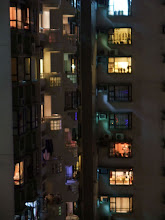
Chungking Mansion

As I research things about Chungking Mansion (CKM) to do my analysis, I've came a cross some websites that do a pretty good job at characterizing CKM. Here are some excerpts:

Best Example of Globalization in Action

" But the housing and commercial complex is visited daily by an estimated 10,000 who trade in everything from secondhand mobile phones to old clothing. Many come from Kolkata (formerly Calcutta) and Dhaka, and a good proportion have overstayed their visas in order to make quick money as restaurant workers or peddlers of counterfeit watches and bags. " by Liam Fitzpatrick

Hope and Squalor at Chungking Mansion
"Take everything that Disney’s Epcot Center represents—the squeaky-clean, child-safe, good-natured cheer of painless globalism—and then cover it in mutton fat, dope resin and human excrement and you’ll get Chungking Mansion. Known as “The Armpit of Asia,” Chungking Mansion is the claustrophobic home for about 20,000 residents from all over the globe. Yet the Mansion also provides a glimpse into one possible over-populated, multi-ethnic future for all of us. This 17-story bazaar of curry stalls, discount electronics vendors, pirated CD and video CD stores, brothels, meth dens and guest houses, provides a glimpse of a dystopian, post-technology future where tribes, cultures and races co-exist in bustling, jumbled squalor. ... No one seems to remember the building’s architect, and the Hong Kong Land Development Corporation has no record of the original design. Perhaps the architect would prefer to remain anonymous, for among the structure’s foibles is that all public space, ... it would be geometrically impossible to create a darker building. " - by Karl T. Greenfeld

" the initial first impression leaves you breathless and without any real understanding of what you have got yourself into and where you are. ...We arrived on the 15th floor to a random small desk and an Afro-Caribbean guy asking my name and requesting 2500 HK dollars for the room...we were given a room on the right hand side, no bigger than the interior of a large square car with white tiles from floor to ceiling - very much like a prison cell. When I saw the window and it was blank and white, I realised that it was decorative and gave us a view of the plaster that separated our room from the next ...Eventually, the ‘hotel’ moved us 3 floors down in the building to the ‘Lucky Hotel’. Lucky Hotel, is a 7 roomed 'hotel' that was once an apartment. All of the hotels in ChungKing mansions have evolved from residential apartments. We were greeted by the ever cheery, Henry, who manages the ‘hotel’ and we now have a room with two windows..." - by Tracey Doxey

http://everything-everywhere.com/2007/12/15/chungking-mansion


"I woke up in the middle of the night to this loud banging and screaming. Once at the corridor it was revealed that the immigration authorities were making a raid on the complex searching for illegal immigrants in the area. ...a Bangladeshi family staying next door was taken away by the officials. Women were screaming in the corridors and terrified children were crying and running around on the scene. It wouldn't have been much of a surprise if a goat and some poultry had come running around there too....when left alone with this African guy in the elevator you could just feel him staring and then saying "Niiiii-cccc-eeeee..." in a way only someone from East-Africa is able to do. Moreover there was a certain sexual connotation in his pronouncing too, so to avoid him being able to offer a blowjob or something. Still a few floors left to go, managed to make it all the way up without any physical harassment. "

oh I just found a great youtube made of the chungking mansion.
Check It! CKM

Thursday, February 19, 2009

Research Part 1: Conclusion

The evolution of Chinatowns is the result of the colonization by the Chinese. Even though they did not begin with the typical colonialism method of establishing a settlement, they eventually inhabited, cultivated and influenced the development of the new territory.

Chinatown’s story on many levels is relatable to the materialization of other (cultural) settlements. These displaced individuals congregated and created a ghetto/ community of their own. While dealing with the constraints of the existing fabric, they re-appropriated the landscape to fit themselves into the desired context.

Looking back at the migratory population in Hong Kong, I will propose to spend the next two weeks studying the infamous ‘Chungking Mansion’ which is perhaps comparable to the Kowloon’s Walled City, due to the densely occupied condition of the building.

Located at a major intersection of the busiest commercial district in Hong Kong, the Chungking Mansion is known for having the cheapest accommodation in Hong Kong. Therefore housing immigrants of different ethnic minorities (mostly temporary immigrants staying indefinitely), while its vacancies are available to other travelers. It also functions as a commercial centre appealing to a majority of the immigrants.

In light of this case study, I hope to find a resolution between the two case studies ‘Chinatown’ and ‘Chungking Mansion’; as both tackles the issue of resettlement of displaced individuals in two very different manner.

Hopefully this will aid me with the development of a “Transient City” or “Center of Refuge” that will facilitate ‘displaced’ individuals (displaced in very loose terms as it has yet to be defined) in both permanent and temporary transition.