Monday, February 9, 2009

Extra! Extra! Read all about It!


The Falcon's Return by Gill Stoner raised an interesting topic. The Falcons that were endangered due to the poisoning of wildlife by our civilization-ing have been brought over to be raised in the urban jungle. Since the tall skyscrapers are just as tall (if not taller) than those of the forest (due to deforestation), the urban conditions have proved to be better and safer for these birds. (...which explains the increasing numbers of birds (hawks and eagles) that i see out of my window in Hong Kong, amongst the skyscrapers!)

The 'nature' in the city is often related to the green parks and the trees located on the side walk. However, " the urban landscaping is no more natural than urban pets, which are conditioned to sleep on couches, eat supermarket food and wear coats when it rains...the contemporary city, born of the forces of corporate capitalism, is now our own second nature." Strategies for survival has resulted in the growth of animals we consider as pests to live in the city. Rats, Pigeons, Seagulls, Cockroaches, raccoons and many more are no longer surviving in their natural habitat, but rather ours. If we disregard what we used to consider rural and urban, (wildlife versus city), the old urban has become the new 'rural', so what is the new 'urban' going to be?

If the existing conditions/ context has come into terms for a new landscape/ ground, then is the re-appropriation done Chinatown considered okay - acceptable? a decorated shed fit for advertising? would it be comparable to the 'big chicken' or 'duck house' ?

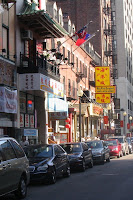
As I walk through (the new/surviving) Chinatown in Boston (this time carefully noticing the architecture), in many sense the streets are full of advertisements! Part of a business tactic... using signs instead of the shouting ‘one dollar, one dollar.’, or having news boys shouting ‘Extra! Extra! Read all about it...’ . Signs located everywhere, added on to the facade above entrances or even protruding out perpendicular to the building. The pre-existing brick commercial buildings and low-rise row houses, has been re-imaged due to homeland nostalgia. As a method of claiming the entry to the community, archways were built despite their awkward setting/ relationships to the surrounding buildings. Despite the changing architecture, the street view of these Chinatowns are outrage and re-appropriated to distinguish familiarize themselves with the sense of home.


Today, Chinatown is a part of the varied heterogeneous American fabric in which Chinese ethnic expression is woven into the American urban scene. The building of archways no longer stand for its old meanings; rather, a commercialization tactic by the city council. This development of the Chinatowns across the world has been quite similar politically, economically and historically.

It seems that Chinatown has become a form of parasite, that is globalized everywhere. As these Paifangs become the symbol, do they become the Starbucks sign for Chinatown? The intention of recreating the existing context to a preferred landscape that is like that of home is lost. Chinatown has now become a commodity, and a place for finding Chinese-ness, not Chinese.

What is the future of Chinatown?

Thursday, February 5, 2009

Networking


Chinatowns are located due to migration. They have always acted as trading posts, apparently due to their capability in business. With the enactment of the Treaty of Peking in 1860, which opened the border for free movement, the numbers of emigration to other parts of the world from China accelerated. Coincidentally, the increasing European colonization in Asia during the mid 1800s resulted in the mass Chinese migration overseas on western ships (steamers). It has been said that from 1868 to 1939 about 6.3 million Chinese left Hong Kong as slaves for the coolie trade. What started out mostly as slavery for the gold rush, located in Australia, North America, Africa ad New Zealand, slowly turned into slavery for the railway industry.

Although the Chinese migrants all came from the coastal area of Guangzhou China, those of different dialects/ linguistic lines traveled to different parts of the world. The Taishanese and Cantonese settled in North America, Australia, Europe and Latin America; whereas the Hokkien and Teochew, moved down to Southeast Asia, Africa, Europe and later, Latin America.
Using these old maps that traced the paths of the Steam-liners taken by Chinese Immigrants, the path taken and stops made concludes the location of various 'major' / 'old' Chinatown.

By studying these routes taken by the steam ships, we can begin to define the origin of each Chinatowns. The pattern of movement across the world map refers to the patterns of migration. Furthermore, understanding that with the spread of word by mouth or letters, more men were bound to travel to locations where they heard of success.

Because of these occurrence, we are able to identify through the style of paifang/ archways the origins of the immigrants. (in this case it would be the regions/ villages in China.)


The paifang dates back to the Zhou Dynasty 11th Century, represented as a marker for entrances, building complexes, mausoleums, temples, bridges, parks or towns. They served as directions, decorating the neighboring community, and used to honor and commemorate deserving people or historic events.

By the Song dynasty, it became more of a decorative movement - losing its true meaning.
Surprisingly, it is arguable that the original intent for the construction of the paifang/ archway in Chinatown is to reroot oneself in the new surrounding. But over the course of history, as Chinatown grows and become globalized, the archway now serves as a means of branding for tourism and commercialization of the area (as promoted by the city-council to reduce the vice of the city due to prostitution and drug use).

The disregard of the existing context/ ground (local vernacular) shows the re-appropriation to be used to feed the need of the people to re-root or familiarize themselves on foreign soil. As ignorance is placed upon the historical (pre)existing industrial architecture the street view is made to remind of home. Resulting with a additive architecture that become inconsiderate to the existing structures or surroundings.

Monday, February 2, 2009

people are weird....

humans are a strange category of creatures.
this has nothing to do with the development of my thesis.
but i'm sitting here in the reading room, watching this man parked next to the beb.
he rolls down the back window and lights a cigar.
but every time he exhales the smoke he rolls down his automatic window, then rolls it back up.
i know its cold out but why does he not just leave the window rolled down.
is he really going to roll his window down and up every single time?
well i'm counting and its already been 6 times and there still a lot of cigar left...
and off he goes...

Saturday, January 31, 2009

is Chinatown a ghetto?

“Migrancy means not only changing places, it also means the changing nature of places.” The idea of architecture by migrancy which is based upon the coming and going of people is unavoidable in this day and age. As our footprint is traceable and imprinted upon the landscape travelled. Wherever we go, part of us gets left behind. Whether it is the rubbish that we have left in the area, or the scars we have left in the landscape. (Monuments, landmarks and buildings we have built).


“Life is not made up of landmarks and destinations, but a series of passageways.”

If landmarks and destinations are viewed as solids or positive spaces, then the moment of transient/ transition which occurs are what that defines the solids. Therefore leaving passageways as the void that we live through unnoticeable, seeing, hearing and learning. These “meaningless” or insignificant spaces are what that provides definitions to the solid that is around it. Their ‘emptiness/ voidness’ services the harmonization of the two distinct opposites (ying and yang). These spaces – passageways if viewed in terms of Lao Tsu’s argument, would be the greyness that provides clarity to the contrasts of the black and white (which in this case would be the Landmarks and destinations).


The transformation/ evolution of the city is altered by its people – migrants. This can be applied to any area, at any point of history and time. The occurrence of these small dislocations may signify the homeland nostalgia, which explains the generation of the beginnings of ethnopolis (Little Italy, Chinatown, etc.). ‘The plain “vernacular” is appropriated by capital and transformed into desirable “landscape”.’ However commercialism has been the key that drives the transformation of the city, therefore ultimately indifferent to the urban vernacular at large.

Take any Chinatown per se, the aspiration of the space provides a false sense of belonging – as though you were in China but on foreign soil. It can be perceived as a place whose self definition is actually portrayed in the symbolic landscapes and the re-appropriation of the vernacular spaces. (Although this might be a false image and wrongly perpetrating the true identity of the place.)


Looking at the history of Chinatown, despite their dispersed locations, they are mostly close to the sea. This pertains to their historical relevance of seamen traveling around the world to look for jobs and earn money to send home. The money they send home helps to raise their family, their success is spread by word of mouth to others in the homeland and thus provoking others to do the same.


As more people arrive, discrimination towards the Chinese increases: mostly due to the cheap Chinese laborers that become competitors to the local laborers. By isolating themselves from the rest of the society, and congregating to live together protects them from the others – creating a comparable center of refuge.


The following experiences would be a brief historical recount on what I think can be applied to mostly all Chinatowns - a stage of male dominant cheap laborers, drug and prostitution center (red light district or association with oriental exoticness), discrimination (exclusion), (finally) arrival of families, women and children, establishment of institutions and self-governing associations, commercialization and finally tourism.


The purpose of any refugee center is to facilitate or assist the resettlement of immigrants and multi-ethnic communities. Does the early stages of Chinatown fit into this description? Or perhaps this is where Chinatown is comparable to a ghetto. Despite the progression it has made though history, it start off as a poor section of the city with a high populated slum inhabitant of people of the same race and social background; resulting from social and economic restrains and pressure and hardships due to the occurring stereotypes.


With these layers of meaning that goes into the concept of Chinatown makes it wonderfully elusive – hard to define. Its layers are incorporated with the landscapes which it sits in. Wherever these Chinatowns are located, they have transformed the local architecture and urban design of that certain region of the country. The effects of migrancy have left behind landmarks, engraving their homeland nostalgias in the landscapes.


As we transit into this ethnopolis (Chinatown) most of us are unaware of the minor adjustments made by the migrants. The alterations are so minute that the awkward fitting-in goes unnoticed unless there is a arch that signifies the entry. We walk through the passageways, only experiencing the transition into a new environment through our senses.

Sunday, January 25, 2009

Chinatown (S)

chinaSo as I begin researching about different methods of alternations/ adaptations of local vernaculars, I thought what a good way it would be by looking for something consistent around the world - to my realization it was Chinatown(s). It is apparent to me that there is always a Chinatown somehwere you go, or located closeby. Whether it be a giant community or a small couple of shops.

Here we go.....


Apparently there is only one Chinatown in India. Located in Calcutta. Here is a clip of the place. Although it is in Hindu, I suppose you can get the gist of the place with the few lines of spoken English and of course if you can recognize the Chinese characters.


As a method of tracking these discoveries, I made a google map of these Chinatowns.

Monday, January 19, 2009

In attempting to further refine my interests, I picked up <Drifiting: Architecture and Migrancy> edited by Stephen Cairns. The article by Ackbr Abbas Building Hong Kong: From migrancy to disappearance, made me realize the unconscious struggling truth about Hong Kong. It is clarifies the difficulties one has when asked "what is Hong Kong like?"

"Hong Kong has gone through a series of mutation and reinventions, moving from local manufacture to global finance." the built up of Hong Kong as an international finance center, is really due to the constant influx of visitors and immigrants. The dependency or importance of the service sector (on all levels: from servants to stock trade) has brought about people of all types and for all purposes.

One particular sentence that stood out was "Migrancy means not only changing places; it also means the changing nature of places." which got me to think about the development of HK. Instead of focusing on the migratory path of immigrant and emigrants (or their purpose of departure and methods of comfort), it is the transformation/ evolution of the city as altered by these people. Whether people come or go, the experience of migrancy is unavoidable as its footprint is traceable / imprinted in the landscape.

As new trend and hotspots arise, Hong Kong's anonymous urban vernacular (local) areas, once unremarkable and unfashionable become gentrified. Local areas become infiltrated with Western culture alterations yet preserved in some way, and if anything are designed indifferent to its surroundings and dislocated from the Local. These series of small dislocations, help articulate homeland nostalgia's (hence the generation of ethnopolis - places such as Little Tokyo, Chinatown and in HK - Soho).

Architecture by migrants is not located just in Hong Kong. It occurs everywhere else too.
The aspiring desires of these spaces provide a false sense of belonging - being in Hong Kong, Europe and America all at once.

...to be continued...

Wednesday, January 14, 2009

Transition

What is the definition of Transition, whose Latin meaning is "to go across". What if transitioning serves as a means of connection, as its existence is based on the acknowledgment of "the binary"/ the opposites. So what are we connecting? Dots?
Possibly. Since the harmonious co-existence of two distinct opposites are vital (Ying & Yang), any negative-ness is apart of the positive. Its final completion is dictated by the natural processes as oppose to what we dictate. In other words, no matter what the original intention is, the conclusion will be self determined. Lets take the relationship between White and Black as an example. White is only positive when placed in contrast to black, since it becomes negative when black is viewed from another viewpoint. Despite their oppositions, they are dependant on each other. Just as noticed with the optical illusion above, white tries to supply black as a balance. However, their proximity may contribute to the loss of definition/ clarity. The fusion between the contrasting hues is already modified by the action of contrast, and thus destroying the physical form defined by them. Yet, it is because of the presence of greyness (fusion from contrast) that clarity is preserved. Thus, the appearance of the grey dots? Scientifically explained - the eye and brain is playing tricks on each other. However really it is the contrast of the black and white, highlighting the deception cause by the perception of depth.

like so:


"whenever a color contains greyness, it has its intangible content of its opposite and thus is capable of harmonizing with its opposite at ease...the more greyness a color has, the more it loses its tangible being and the more variety potential it has."

Greyness therefore represents the acknowledgement of the co-existence of these two different values. For white is not white without the existence of black, the same kind of grayish surface will appear brighter in contrast with black but darker in contrast with white. -- This same concept also applies for Solids and Voids. even though voids are often regarded as negative, it is more important as it is always capable of being filled by the solid.

think i'll stop now. not sure where i'm going with this...

Thursday, January 8, 2009

From Childhood to Adulthood

So I was zapping the channels one day, and started watching Star Trek 9, Insurrection, and a interesting topic was brought up...

Artim (a child) and Data (a robot) takes interest in each other's lifestyle: wondering what is it like to be a child/ a robot. The brief conversation exchanged between them brought up a small interesting subject

--- ---
Data: Perhaps it would surprise you to know that
I have often tried to imagine what it would be like to be a child...
Artim: For one thing, your legsare shorter than everyone else's.
Data: But the are in a constant state of growth. Do you find it difficult to adapt?
A child's specifications are never the same from one moment to the next.
I a surprised that you do not ...trip over your own feet.
Atrim: Sometimes I do.
Data: My legs are eight-seven-point-two centimeters.
They were eighty-seven-point-two centimeters the day
I was created. They will be eighty-seven-point-wo centimeters the
day I go offline. My operation depends on specifications
that do not change. I...cannot imagine... the experience
of growing up or even tripping over my own feet...

Unlike robots who are brought into the world with one specification, humans (particularly Childrens) are in constant growth and therefore always changing their sizes. The growth of the human body, demands adjustments to the changing bodily measurements. Surprisingly this happens through-out our life without much awareness. Asides from new clothes and shoes to fit our dimensions, much of the changes and adjustments go unnoticed.

If we say architecture is similar to the Human Body as it breaths and has both skin and bones. Then with this argument, perhaps something is also missing. Perphas it is the growth of the building, other than the extensions and material decay, the buildings don't really transform or grow/age anyother way (or do they? )

Anyways, The readjustments we make to the on-going modifications of our growing body, is often forgotten as it become a habitual and ordinary; therefore insignificant. We have become so accustomed to re-fitting/ adjusting that we have become so unaware to it. Adaptation is second nature and hence taken advantage of.

The adaptive quality (in architectural terms?) should not be solely to site conditions and surroundings, but also to the people and development of the society (or social surroundings).

On a side note: On my journey back to Providence from Hong Kong, I was stuck in Newark because of the snow storm, I met a lady from a children's art education company. An interesting topic concerning the facilities for child development was brought up. She brought up simple issues such as the dis-coordination between children facilities and their method of development, as well as their sizes. For example, for those ages between 3- 6, the windows are too high for them to look out, the shelves are too high for them to reach. Therefore interrupting with their maturation? or advancement.

We also discussed about possible design solutions of the spaces, actually particularly about the materials used in the interior. such as mirrors which would help develop their understanding of the facial features (thus preventing them drawing the facial features all in the straight vertical line.) as well as green materials such as bamboo, cork and many more...

So the growth/ development can be considered as a type of transition from childhood to adulthood. Then perhaps one way is to rethink the design of a daycare center, or school/ nursery/ kindergarten; where the design of this space is specific to each of the stages of growth.
For example, having windows at located at different heights off the ground for the different age range..as well as furniture (which already exists) but then the design of each room for each specific age range could generate or facilitate with a child development (or understanding of the world he or she lives in) .


AChild Developmen Center in Ohio
vs.


vs.

The Els Colors kindergarten, designed by RCR Arquitectes


Thursday, January 1, 2009

Macau

Over Christmas Went to Macau, asides from the extensive growth of Casinos, and the famous cathedral that was bombed and only one facade left behind...I found this old style house that was open to the public. 3 story building, with high ceiling very airy and cool. Light Wells located in the center with drainage at the end..dividing the large room into two with equal lighting...


Wednesday, December 31, 2008

seclusion

As Cities grow the communal culture once noticed amongst villages diminishes. We who live so close to each other are yet so distant. Neighbors act like strangers, but on a strange occasion: only when we need the help of another, we bother to become acquainted (so to speak). Least the experience of living in a 37 floored building with 2 apts on each floor has proven. Had I not know of the two students from my same school living in the same building, I would have not known anyone in the building. Why is this so?

In the village conditions, despite distance amongst families their dependency and reliance on each other is so great that everyone knows of each others business. Where as here those living one above another are so disassociated with each other, that they become strangers. (is this considered a part of a urban decay?...)

...the lost of public space is related to the loss of public life because introverted private lives have eclipsed both...(such in The Fall of Public Man by Richard Sennett)

As we become closer to one another, we may become more estranged. The advancement of technology has strangely brought those separated by the pacific to be closer that those living next door to each other...

...the again as architects design buildings to accommodate everything, "life" (as we call it) moves inwards (cinemas, theaters, schools, museums, aquariums, gymnasiums, swimming pools...), outdoor life is left behind. It is as if that as we become more technology dependent, we trade in the "nature" condition for one that we can control...(power!)

...as proven by the increase of residents in cities therefore the diminishing villages and their cultures. young people from the rural villages are leaving their home and moving to the cities where they can earn more money...leaving a farmers life behind and moving to work in front of computers or (more like) inwards...

(on a separate note: when the younger generation leave the rural villages, they are also endangering that particular culture of their region. the elders stay behind awaiting for the return of their children, but of course many choose the better life which they have found in cities. Few ever return to their past lives. As they say Until you have gained knowledge of what else is out there, the world is as (informed as)you know it. )

oh going back to say that ... as we move our lives inwards, the public spaces become buildings. therefore there is a lack of public outdoor spaces, or the usage of these spaces. the usage of parks though seem high in demand become less used.
(IF The city's population density of 26,403 people per square mile (10,194/km²) and Central park is 843 acres or 1.32 sq mi (3.4 km2), According to that calculation, Central park can only occupy 34852 people (so to speak). So imagine if even 5% of Manhattan residents actually all went/used to Central Park ...it'd be like the amount of people gathering to watch the new years countdown in Times Sq) So there is a need to generate more public spaces, but more importantly, a purpose is needed to bring people to the outdoors. Some sort of attraction that brings life back to the outside.

Another example would be the podiums that we have here in HK. Every estate/ tall buildings, has some sort of outdoor garden that serves to divide the residential from the parking garages or commercial area. So instead of having a blank roof, a podium - acting as a type of "green roof", as well as "garden", is created. But really if i were to count the number of people who use that space, theres just a handful compared to the amount of residents in the estate.
The Elderlies do their morning workouts, then during the day the maids bring the children to play (thats if there is no school). Some people jog (but then it gets boring since its quite small) others walk around in circles for fresh air and a bit of exercise. ( come to think of it, with everyone upstairs in the apartments able to look down and 'watch' you, its kind of like a prison/ zoo. )
So other than these brief activities, there has to be a larger force, motivation/ attraction to bring people together. To create a proper community as in the villages, a place of interaction to diminish the amount of ongoing seclusion.